Home / Statistical Tools / Reliability / Censored / Reliability: Interval, Left, and Right Censored Data Format
Reliability: Interval, Left, and Right Censored Data Format
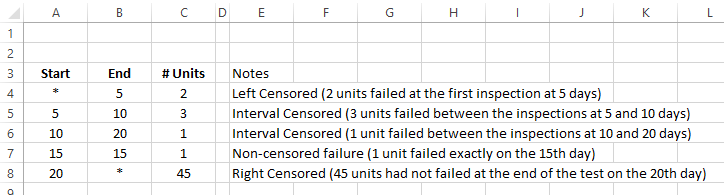
When your data includes some form of censoring, you need to enter your data in pairs. An example which includes all three types of censoring is below.
Left Censored
The unit is a left censored failure if it failed before the first inspection. In the example above, two units failed at some time between the start of the test and the first inspection at 5 days. Denote a unit as "Left censored" by placing a non-numeric value in the Start column and the time that the first inspection was made in the End column.
Interval Censored
The unit is interval censored if it failed between two inspections. In the example above, three units were discovered failed in the inspection on the 10th day. At the previous inspection, on the 5th day, these units had not failed. Therefore, they failed sometime between the 5th and 10th day. Denote "Interval censored" by placing the time of the last passed inspection in the Start column and the time of the failed inspection in the End column.
Exact Failures
If you know the exact time of failure, then you can denote that by placing the time it failed in both the Start and End columns. In the example above, one unit failed at the 15th day. Note that it would be very unlikely that the failure would occur exactly 15 days after the unit was put on test. If the unit failed 15 days and 12 hours after being placed on life test, then you should enter 15.5 for both the Start and End columns.
Right Censored
The unit is right censored if it has not failed when the life test is complete. In the example above, 45 units were still functioning after the inspection on the 20th day. Due to fiscal constraints, this was the last inspection and the experiment was terminated. Thus, 45 units never failed when the test concluded. Denote "Right censored" by placing the last passed inspection time in the Start column and any non-numeric value in the End column.
Practical Considerations for Time
In this example, the unit of time was days. However, other units are valid. For example, minutes, hours, weeks, and months. In some cases, "time" can be surrogates for time, for example miles to failure, cycles to failure, etc.
Censored data can be fit using either Auto-Fit or choosing a distribution manually.