Home / Statistical Tools / Analysis Tools / Pareto / Examples / Count Frequency
Count Frequency
When your data includes counts that need to be aggregated by category, use a Count column as the frequency. Quantum XL automatically sums the counts for each category—you don't need to pre-summarize your data.
Goal
Create a Pareto chart from defect counts where the same defect type appears multiple times. Quantum XL will aggregate (sum) the counts for each category automatically.
Sample Data
Download Pareto_CountFrequency.xlsx
Excel Protected View
When you open downloaded files, Excel displays a Protected View warning. You must click Enable Editing before you can use Quantum XL with the file.

Alternatively, you can copy the sample data from the table below and paste it directly into a new Excel workbook.
| Defect Type | Count |
|---|---|
| Scratch | 35 |
| Dent | 8 |
| Scratch | 25 |
| Crack | 2 |
| Scratch | 18 |
| Dent | 4 |
| Scratch | 12 |
| Crack | 1 |
| Scratch | 7 |
| Scratch | 3 |
Notice that "Scratch" appears 6 times, "Dent" appears twice, and "Crack" appears twice. This is typical when data comes from multiple sources, time periods, or inspection batches. Quantum XL will automatically sum the counts:
- Scratch: 35 + 25 + 18 + 12 + 7 + 3 = 100
- Dent: 8 + 4 = 12
- Crack: 2 + 1 = 3
Steps
-
Launch the analysis
From the Excel ribbon, select QXL Stat Tools → Analysis Tools → Pareto.
-
Select your data
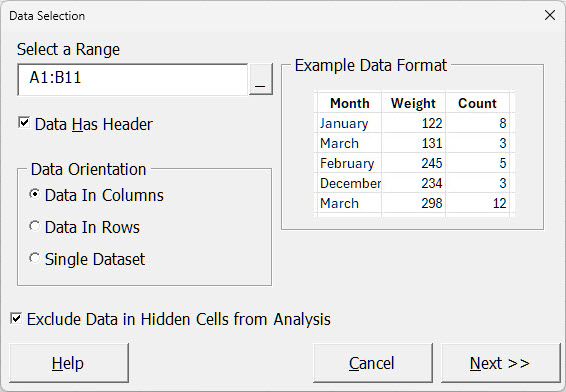
Select cells A1:B11 (the header row plus all 10 data rows).
-
Configure the analysis
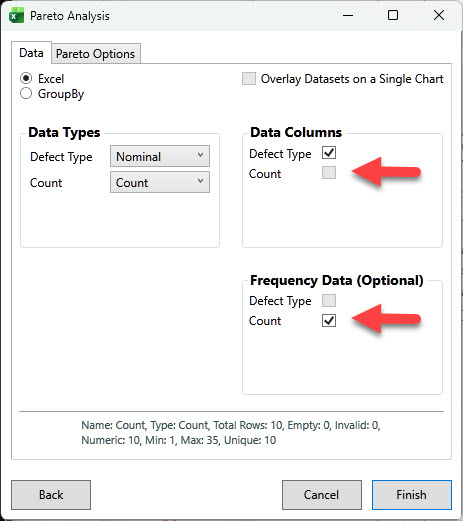
In the Pareto Analysis dialog:
- Deselect "Count" under Data Columns (if auto-selected)
- Check "Count" under Frequency Data (Optional)
Click Finish to generate the chart.
Result
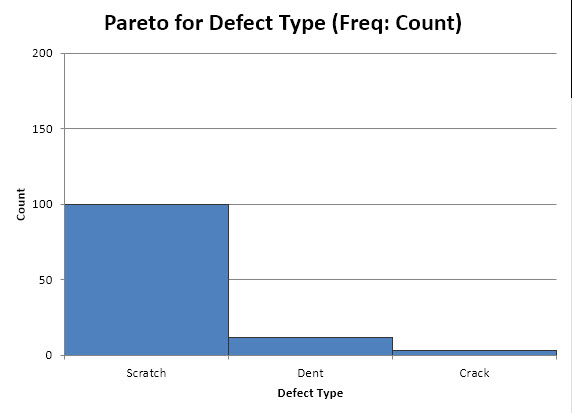
Quantum XL aggregates the counts by defect type and creates the Pareto chart:
- Scratch accounts for 100 defects (87% of total 115)
- Scratch + Dent together account for 112 defects (97% of total)
- All three defect types total 115 defects (100%)