Home / Statistical Tools / Hypothesis Tests / Power And Sample Size / Power test for Two variances test
Power and sample size for Two Variances test
From Excel click...
QXL Stat Tools Tab > Hypothesis tests > Power and Sample Size > Two Variances test
This test is used to perform power and sample size analysis for the two variances test.
Step #1 -- What to calculate
Quantum XL can calculate one of the following parameters, when the other two are provided:
- Sample size.
- Power of the test.
- Ratio between two standard deviations (StDev 1 / StDev 2).
Step #2 -- Provide known parameters

After telling Quantum XL what to calculate, you need to provide the other two parameters. For example, if you are interested in sample size, you will have to provide Power of the test and the Ratio.
Parameters can be entered as single values (default), or you can provide a range of values. In order to provide a range of values:
-
Click 'advanced input mode' button.
-
Enter 'From', 'To' and 'Step' values. Example: If you enter the following values for sample size, 'From'=2, 'To'=10 and 'Step'=2, Quantum XL will perform calculations for sample sizes 2, 4, 6, 8 and 10.
Quantum XL will report results for all combinations of the provided values. If you have provided 5 sample sizes and 2 Ratios, Quantum XL will report 10 power values. Maximum number of results is 100.
Limitations:
-
Minimum sample size is 2.
-
Power values must be greater than 0 and less than 1.
-
Ratio is a number greater than 0.
-
If sample size is being calculated, Ratio must be:
- not equal to 1 for 'not equal' test.
- less than 1 for 'less than' test.
- greater than 1 for 'greater than' test.
Step #3 -- Alternative hypothesis
'Advanced options' tab allows you to select between one sided and two sided tests.
- Not Equal. Perform two sided test.
- Less than. Perform lower-tailed test.
- Greater than. Perform upper-tailed test.
Step #4 -- Alpha level (decision criteria)
Alpha level is a probability of committing type I error. The greater the value, the greater the power of the test.
Default value is 0.05.
Step #5 -- Method
Calculate power and sample size using Levene's or F-Test method. F-Test is appropriate if samples come from normally distributed populations. If samples are not normally distributed, use Levene's method (default).
OUTPUT
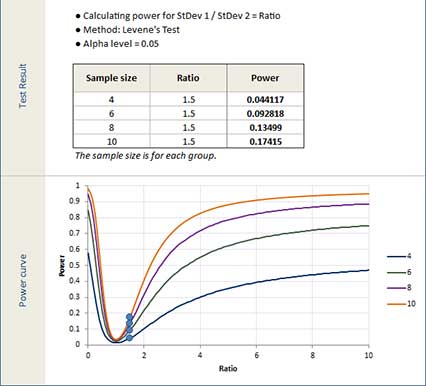
Quantum XL will report results for all combinations of the provided values. Report includes table with Sample Size, Ratio, Power and Actual power values, and a power curve. The power curves graph has Ratio on the X-Axis and Power on the Y-Axis. One curve is plotted per sample size.